Table of Contents
Plant training is one of the more common methods of cultivation techniques used by growers. It is used primarily to train plants to grow in a way that will maximise crop yield and structure. Training increases leaf surface area for light penetration, creates stronger branching and increased foliage.
“Marijuana is not a drug… it’s an herb.”
– Tommy Chong
A bit of growth will always occur on its own on an indoor plant, but a good amount of training is often necessary to help maximize the growth of the plant. The main reason is that the light provided by the grow light only reaches a certain area directly around the light itself. By training the plant you can assure that the largest portion of the plant is receiving light.
This growing guide will cover the most common methods of cannabis plant training, their impact on growth and the effects they have on the size and yield of buds.
Why Plant Training Is Important
Cannabis plants will naturally grow in a particular fashion due to a phenomenon known as apical dominance, where the central stem or main top bud always grows to be the dominant bud. What this means is that the main top bud will always receive more energy and light.
Trained plants promote the spread of plant growth hormones and multi bud sites instead of having a single cola at the top of the plant.
Benefits of plant training include:
• Increased light exposure • More bud sites • Better airflow between branches • Improved yield potential • Better canopy control for indoor growing
Good airflow from a proper grow tent ventilation system helps prevent mold and improves plant health.
Low Stress Training (LST)
Low Stress Training (LST) is quickly becoming one of the most popular methods of training for growing indoors. The method involves making the stems of the branches bend to a desired direction by gently twisting them and then tucking and securing them to promote an even canopy.
A technique used in cannabis cultivation to train the plant so that lower branches receive more light, with the idea that these lower branches will grow into more fruitful bud sites.
LST is particularly effective for:
• Autoflower cannabis strains
• Small grow spaces
• Indoor grow tents
LST does not really stress the plant heavily. Therefore it is possible to perform LST on almost all phases of growth.


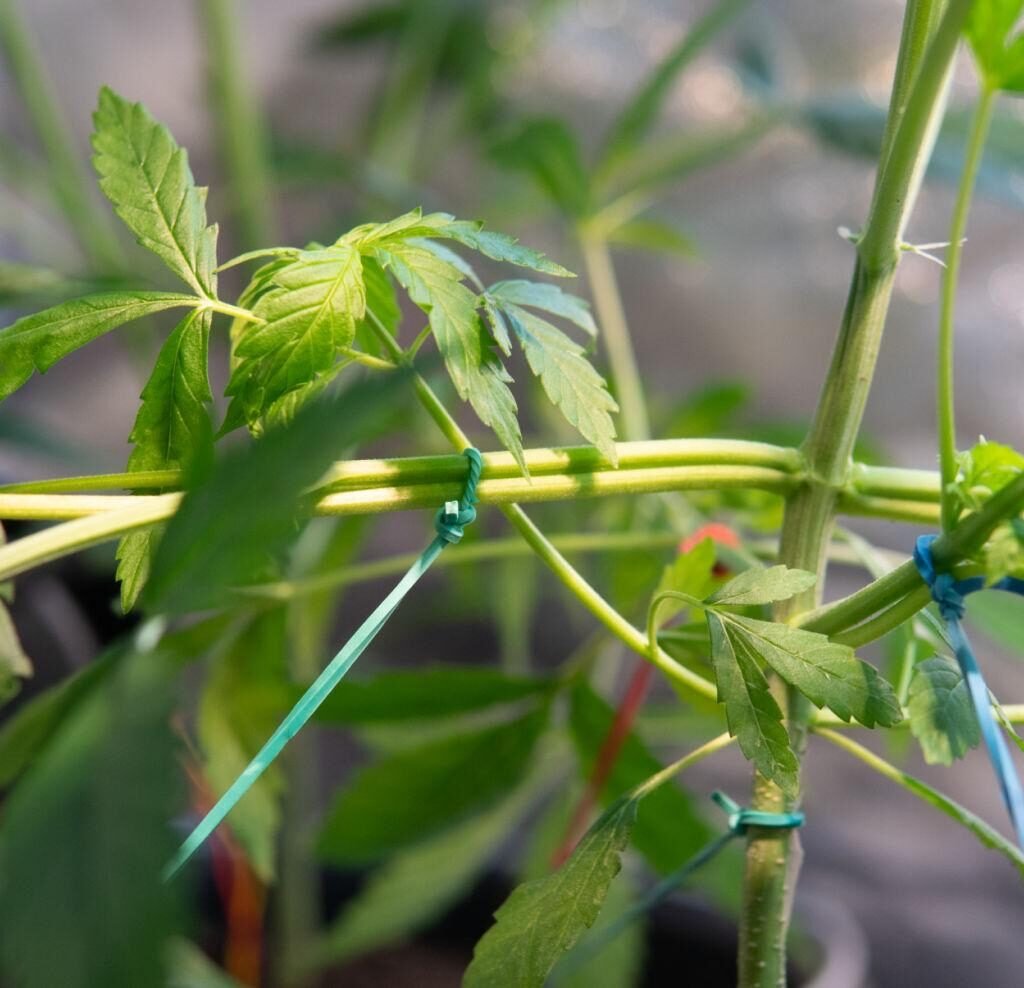
Topping
TOPPING 101 If we remember that when a seedling is planted, it starts to grow an apical bud (the main stem of the plant) and loads of branches and leaves, a grower simply has to prune this main stem (apical bud). When this bud is cut, two new branches and growths begin to sprout at the cut junction, creating two shoots of similar height. Each new growth that forms at this height then sprouts further growths of the same height, creating several similar shoots at the same height. It is important to understand that this effect creates plants with a short structure
Healthy plants respond better to training when they receive the best nutrients for cannabis in coco.
By topping out your plant you are essentially forcing the plant to grow two main colons rather than one. This will lead to a fuller plant and more bud sites during flowering.


When to Top? Topping is usually carried out during the vegetative phase of a plant’s life cycle. Usually after the plant has 2-4 sets of leaves.
Screen of Green (ScrOG)
Screen of Green (SOG) definition: A training method in which a mesh screen is placed above the top foliage of the plants.
As the limbs start to fill the screen they are then laid out evenly across the trellis. Giving an even canopy for the light to shine down upon the flowers.
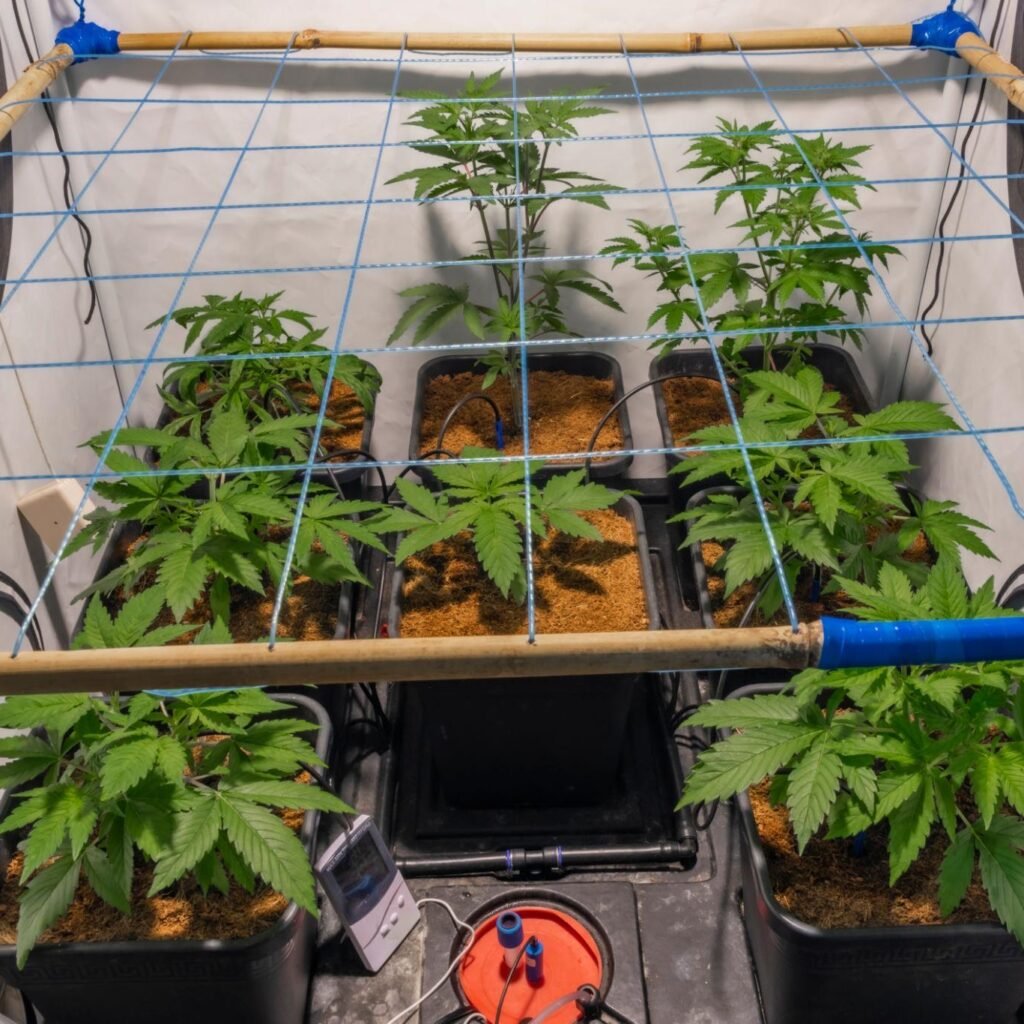

ScrOG is ideal for the grower with limited space that wants to grow the most plants possible.
Defoliation
Defoliation is the process of removing select fan leaves to increase light to lower leaves and to improve air flow through the plant canopy.
If done correctly, this type of pruning will direct more energy toward flower development.
Foliar spray defoliation is a growing tool in the grower’s toolkit, but it should be used in moderation and with care. Over defoliation can cause plant stress, so defoliation should be done in phases.
According to Grow Weed Easy, techniques like LST and topping can dramatically improve indoor yields.
Common Plant Training Mistakes
While plant training can significantly improve yields, beginners sometimes make mistakes.
Common issues include:
• Training plants too early
• Bending branches too aggressively
• Removing too many leaves at once
• Training during the flowering stage
Proper timing and gentle handling are key to successful plant training.
💡 Tip: Combining multiple training methods can significantly increase indoor yields.
| Training Method | Difficulty | Best For | Main Benefit |
|---|---|---|---|
| Low Stress Training (LST) | Easy | Beginners | Improves light distribution |
| Topping | Medium | Photoperiod plants | Creates multiple main colas |
| Screen of Green (ScrOG) | Medium | Indoor grow tents | Maximizes canopy efficiency |
| Defoliation | Medium | Experienced growers | Improves airflow and light penetration |
Final Thoughts
Plant training is an important aspect to consider when growing cannabis indoors. Low Stress Training (LST), topping and ScrOG are some of the ways to increase the yield of your harvest. Learn more with WEED.
Optimal training, adequate lighting, nutrient supply and environmental conditions provide the basic for strong, healthy crop plants.
With a bit of practice and patience, plant training can become one of your most useful indoor growing tools.
What is the best cannabis plant training technique for beginners?
Low Stress Training (LST) is often considered the best method for beginners because it gently bends branches without causing major stress to the plant.
When should you start training cannabis plants?
Most growers start plant training during the vegetative stage when the plant has developed several nodes and strong branches.
Does plant training increase cannabis yield?
Yes. Plant training improves light exposure across the canopy and encourages the development of multiple bud sites, which can significantly increase yields.